
This document is an introduction to PLL design and usage in Altera Cyclone FPGAs
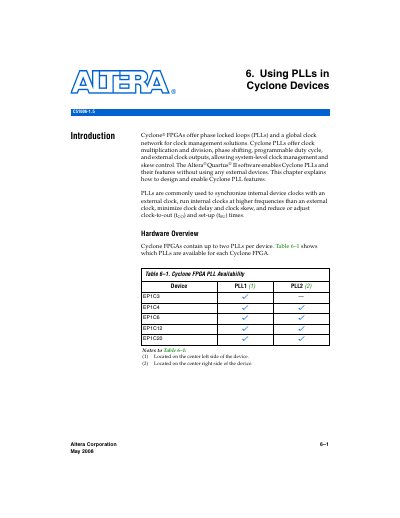
Cyclone FPGAs contain up to two PLLs per device that offer clock multiplication and division, phase shifting, programmable duty cycle, and external clock outputs. These features allow for system-level clock management and skew control without the need for external devices.
The document details how to enable Cyclone PLLs using the altpll megafunction in Quartus II software. It describes the internal components of the PLL block diagram, including the Phase Frequency Detector (PFD), Charge Pump, Loop Filter, and Voltage Controlled Oscillator (VCO).
| Number of PLLs per device | up to two |
|---|---|
| Clock multiplication and division range | 1 to 32 |
| Phase shift increment | Down to 125-ps increments |
| Number of internal clock outputs per PLL | Two |
Cyclone PLLs are enabled by using the altpll megafunction.
It acts as a combined enable and reset signal; driving it low disables outputs and loses lock, while driving it high starts the re-synchronization process.
No, you must drive Cyclone PLLs by the dedicated clock input pins CLK[3..0].