
This application note presents the design guidelines for Quasi-Resonant Converters using FSCQ-series FPSTM (Fairchild Power Switch) in color TV applications. A Quasi-Resonant Converter (QRC) offers lower electromagnetic interference (EMI) and higher power conversion efficiency compared to conventional hard switched converters. It is particularly suitable for noise-sensitive color TV applications. The note includes practical design considerations for the transformer, output filter, sync network, component selection, and closing the feedback loop. The step-by-step design procedure described in this application note provides engineers with an easy way to design Quasi-Resonant Converters. Additionally, a software design tool called FPS design assistant, which incorporates all the equations described in this application note, is provided to enhance the design process. The design procedure is verified through an experimental prototype converter.
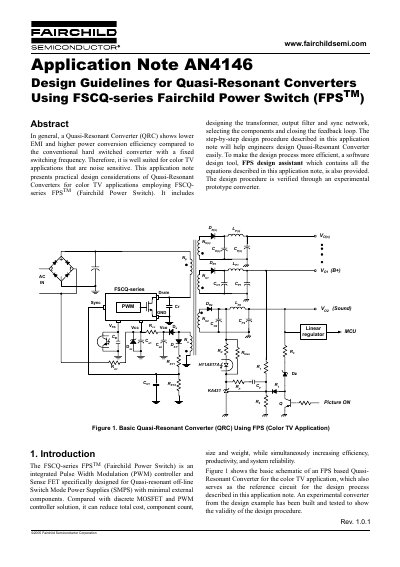
The document presents practical design considerations for Quasi-Resonant Converters (QRC) specifically for color TV applications, utilizing the FSCQ-series integrated PWM controller and Sense FET. It aims to help engineers reduce component count and cost while increasing efficiency compared to discrete solutions.
A detailed step-by-step design procedure is provided, covering system specification definition, DC link capacitor determination, transformer design (primary inductance, core selection, turns calculation), and the design of output filters and feedback loops. The note also includes a software design tool reference.
The typical efficiency for color TV applications is estimated to be between 80% and 83%.
The minimum switching frequency should be higher than 20kHz, and it is typically set around 25kHz.
It is typical to set VRO between 120V and 180V.
The typical value for the falling time (TF) of the MOSFET drain voltage is between 2 and 2.5 microseconds.