
This document describes the assembly guidelines for the Fairchild Dual Power33 package, which uses Molded Leadless Packaging (MLP) technology and has low package height and excellent thermal performance.
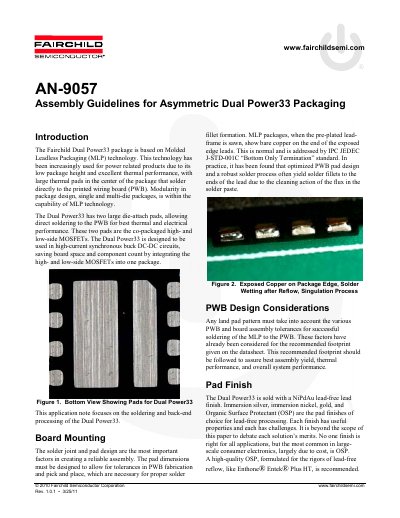
This document serves as an application note (AN-9057) detailing assembly guidelines for the Fairchild Dual Power33 package, which utilizes Molded Leadless Packaging (MLP) technology. The package integrates high- and low-side MOSFETs for high-current synchronous buck DC-DC circuits, offering low profile and excellent thermal performance through direct soldering to the printed wiring board (PWB).
| Package Technology | Molded Leadless Packaging (MLP) |
|---|---|
| Peak Reflow Temperature | 260°C |
| Lead Finish | NiPdAu |
| Recommended PWB Material | lead free FR-4 |
| Recommended Solder Alloy | SAC 305 |
| Temperature Cycle Range | -40 to 125°C |
It is recommended that lead free FR-4 is used in PWB construction to handle lead-free reflow temperatures.
Yes, it is acceptable, but designers should carefully characterize the PWB and process designs with x-ray inspection to ensure there is not a voiding problem.
The lead-free alloy 96.5 Sn/3.0Au/0.5Cu, commonly known as SAC 305, is the lead-free solder paste alloy of choice.
No, a solder fillet is not required on the side of the lead, but one can improve reliability by 20%.