
MAX1005 is a combined digitizer and reconstruction integrated circuit designed to work in systems that demodulate and modulate communications signals. It integrates IF undersampling and signal synthesis functions into a single, low-power circuit.
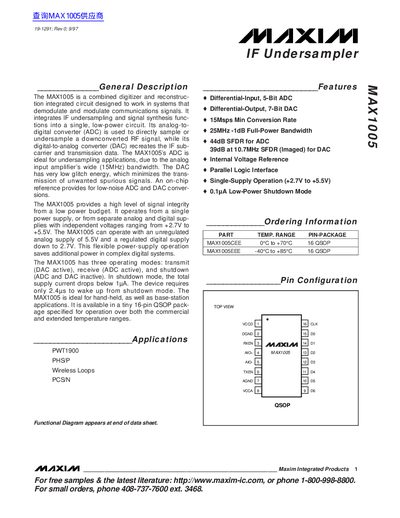
The MAX1005 is an integrated circuit designed to work in systems that demodulate and modulate communications signals. It integrates IF undersampling and signal synthesis functions into a single, low-power circuit. The device features a differential-input, 5-bit ADC for directly sampling or undersampling downconverted RF signals and a differential-output, 7-bit DAC for recreating the IF subcarrier and transmission data.
The MAX1005 operates from a single power supply or separate analog and digital supplies with independent voltages ranging from +2.7V to +5.5V. It offers three operating modes: transmit (DAC active), receive (ADC active), and shutdown. The device is available in a 16-pin QSOP package for operation over commercial and extended temperature ranges.
| ADC Resolution | 5 Bits |
|---|---|
| DAC Resolution | 7 Bits |
| Conversion Rate | 15 Msps |
| Analog Input Bandwidth | 25MHz -1dB Full-Power |
| ADC SFDR | 44dB |
| DAC SFDR (Imaged) | 39dB at 10.7MHz |
| Package Type | 16 QSOP |
The device has three operating modes: transmit (DAC active), receive (ADC active), and shutdown.
The device requires only 2.4µs to wake up from shutdown mode.