
This document introduces a new method that combines immunoprecipitation with Agilent High Sensitivity Protein 250 assay on Agilent 2100 Bioanalyzer to detect proteins on a microchip with high specificity and sensitivity. This method is useful for protein expression and purification research in fields such as pharmaceuticals, biotechnology, and specialized research institutions. Compared to Western blotting, this method offers more reliable results, better accuracy, improved productivity, reduced antibody costs, and lower reagent consumption.
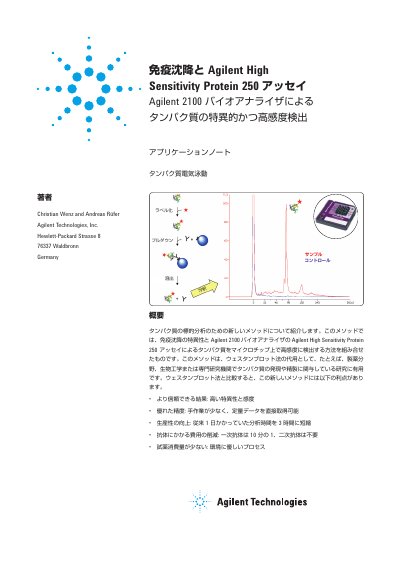
This document presents a new method for the specific analysis of proteins using the Agilent 2100 Bioanalyzer and the Agilent High Sensitivity Protein 250 assay combined with immunoprecipitation (IP). This IP/HSP250 method offers higher reliability, accuracy, and productivity compared to traditional Western blotting, while reducing costs and reagent consumption. The workflow involves labeling proteins with a fluorescent dye, performing immunoprecipitation using Protein A magnetic beads and specific antibodies, and analyzing the eluted proteins directly on a microchip.
The performance of the IP/HSP250 method is demonstrated using a sample of E. coli cell lysate containing GST-tagged PTEN. The document details the experimental procedures, including sample preparation, labeling, immunoprecipitation steps, and on-chip analysis, and compares the results with traditional Western blotting techniques. This manual is written in Japanese.
The total time required for the IP/HSP250 method is approximately 3 hours.
The concentration of the GST labeled PTEN protein added to the sample is 100 ng/uL.
The anti-GST primary antibody was diluted to a ratio of 2000:1.