
This application note describes the methods for conventional HPLC analysis and Rapid Resolution LC (RRLC) analysis of Radix Bupleuri, a traditional Chinese medicine. The comparison of the fingerprint chromatograms of multiple Radix Bupleuri samples showed that different herbal medicines from different sources have different peak profiles. The method for Agilent 1200 Series evaporative light scattering detector (ELSD) was optimized to obtain maximum response. A quantitative method was developed to measure six glycosides in the herbal medicine and its preparations.
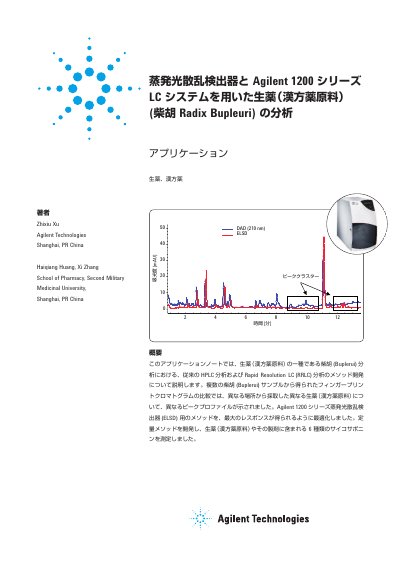
This document details an analytical method developed to analyze Radix Bupleuri (Shaku), a traditional Chinese medicine ingredient. The study compares conventional High-Performance Liquid Chromatography (HPLC) with Rapid Resolution LC (RRLC) techniques, utilizing both Diode Array Detection (DAD) and Evaporative Light Scattering Detection (ELSD). This manual is written in Japanese.
This document explains method development for analyzing Radix Bupleuri using both traditional HPLC and Rapid Resolution LC (RRLC) analysis.
The optimized parameters for the ELSD are an evaporation temperature of 40 °C, a pressure of 55 psi, a gain of 7, and a filter of 3s.
The analysis time for the traditional HPLC method is approximately 50 minutes.