
Agilent SampliQ SAX is a solid phase extraction (SPE) product that is suitable for acidic and neutral compounds. It offers excellent reproducibility, a simple extraction protocol and controlled particle size.
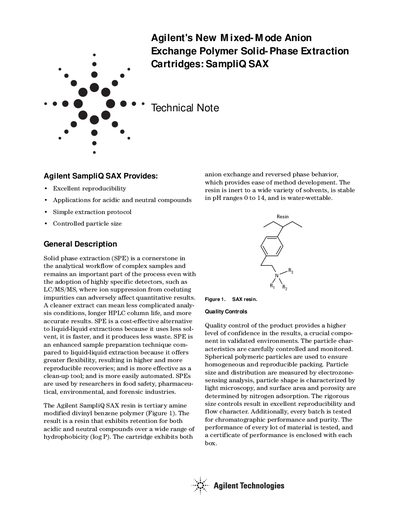
The Agilent SampliQ SAX cartridge utilizes a tertiary amine modified divinyl benzene polymer resin that exhibits both anion exchange and reversed phase behavior. This design allows for the retention of acidic and neutral compounds over a wide range of hydrophobicity, offering flexibility in method development compared to traditional sorbents.
The document provides operational guidelines for a simple five-step extraction protocol: conditioning, loading, aqueous washing, organic solvent wash, and elution. It highlights that the cartridges are compatible with pH ranges from 0 to 14 and are intended for single-use only.
| Resin Type | tertiary amine modified divinyl benzene polymer |
|---|---|
| pH Stability Range | 0 to 14 |
| Recommended Flow Rate | not faster than 1 mL/min |
| Usage Limit | single-use only |
The flow through the cartridge should generally not exceed 1 mL/minute.
No, the cartridges are intended for single use and reconditioning is not recommended.
The cartridges are compatible with solvents from pH 0 to 14.