
A method for quantifying the performance of a DNA microarray reader is described. The method uses standard microarray metrics such as detection limit, signal to noise, and the standard deviation of the log(ratio) to quantify the scanner's combined error. A method is also proposed to measure the scanner's contribution to the experimental error independently. This method can exclude error for other sources such as array synthesis, hybridization, wash and biology.
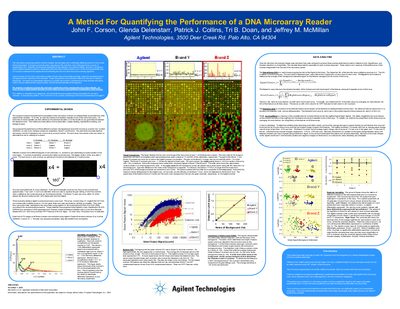
This document presents a method for quantifying the performance parameters of DNA microarray scanners independently of other experimental variables. The study compares the Agilent dual-laser DNA microarray scanner (Cat. Number G2565AA) with two other commercial scanners (Brand Y and Brand Z) using a standardized experimental design involving 180-degree rotation of arrays to eliminate spatial artifacts.
| Array Size | 10777 features |
|---|---|
| Repetitions | 8 scans |
Features with a Signal-to-Noise (S/N) ratio less than 3 are considered undetectable.
The array was rotated 180 degrees to clear uncertainties caused by non-uniformity depending on spatial position.