
The document introduces the applications and features of Agilent Labware Stacker, including small footprint for space-limited labs, ultra-compact storage and dispensing of tip boxes, pin tools or up to 60 ANSI-compliant microplates, and automated systems using articulated arm robots.
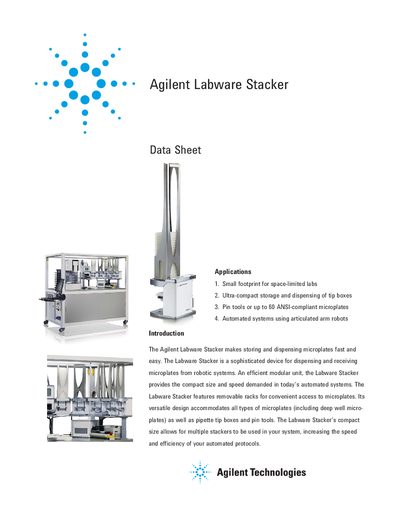
The Agilent Labware Stacker is an efficient modular unit designed for the storage and dispensing of microplates, pipette tip boxes, and pin tools. It features removable racks that accommodate various standard and deep well microplate types, as well as top-load or front-load configurations.
Designed for use with articulated arm robots and automated systems like the Agilent BioCel System, the device offers a small footprint to increase system speed and efficiency. The unit includes an RS-232 serial interface and ActiveX controls for integration into custom or platform-specific software environments.
| Operating Voltage | 100-240 VAC, 50/60 Hz |
|---|---|
| Operating Temperature | 4—40 °C |
| Relative Humidity | 10-90% RH, non-condensing |
| Air Consumption | 28 Lpm at 5.5 bar |
| Interface | RS-232 serial port with DB9 pin connector |
| Standard Rack Dimensions (WxDxH) | 3.5 in x 5.25 in x 26.75 in |
| Device Weight | 6.1 kg [13.5 lbs] |
It is a device for dispensing and receiving microplates from robotic systems.
It requires 100-240 VAC, 50/60 Hz power.
The standard rack can hold 88 thermal cycling microplates without a seal.