
This document introduces the features and advantages of Agilent Poroshell 120 columns and provides method transfer suggestions.
This document provides video commentary and technical guidance for transferring chromatographic methods from conventional 3.5 µm or 5 µm columns to the Agilent Poroshell 120 column. The goal is to improve analysis speed and resolution while reducing solvent usage.
The text details three key instrument parameters that must be optimized when using Poroshell 120: detector response time, flow cell volume, and extra-column volume (including tubing and needle seats). It specifies recommended starting flow rates for different column inner diameters and highlights the benefits of using smaller flow cells and shorter tubing to minimize band broadening. This manual is written in Chinese.
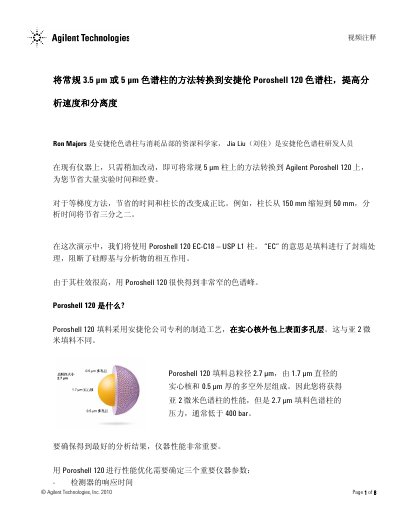
| Particle Structure | 1.7 µm solid core with 0.5 µm porous outer layer |
|---|---|
| Total Particle Size | 2.7 µm |
| Maximum Pressure | Below 400 bar |
| Recommended Data Acquisition Rate | 40 Hz or higher |
| Starting Flow Rate (2.1 mm ID) | 0.42 mL/min |
Analysis time is reduced by two-thirds if the column length is shortened from 150 mm to 50 mm.
Red tubing (0.12 mm ID) is recommended because its volume is half that of green tubing (0.17 mm ID).