
This document explains how to transfer methods from conventional 3.5 µm or 5 µm columns to Agilent Poroshell 120 columns to improve analytical speed and resolution. Poroshell 120 particles are manufactured by Agilent using a proprietary process that creates a superficially porous shell around a solid core. These columns will work on virtually any HPLC and can be scaled from conventional 3 or 5 µm columns with minor modifications to the instrument. Poroshell 120 columns are available in an endcapped EC-C18 phase and a non-endcapped StableBond SB-C18 phase, with more phases coming soon.
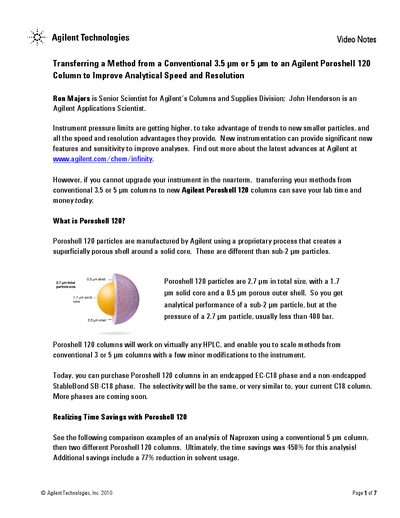
This document provides video notes and technical guidance on transferring analytical methods from conventional 3.5 µm or 5 µm columns to Agilent Poroshell 120 columns. The Poroshell 120 particles feature a superficially porous shell around a solid core, offering sub-2 µm performance at lower pressures (usually less than 400 bar). This transfer allows labs to save time and money without upgrading instrumentation immediately.
The guide details key instrument parameters for optimized performance, including data collection rates, flow cell selection, and minimizing extra column volumes. It recommends using micro flow cells (3 mm/2 µL) for 2.1 mm ID columns and suggests specific starting flow rates based on column internal diameter (e.g., 0.42 mL/min for 2.1 mm ID). The document also covers proper tubing connections and fitting types, such as using polyketone fittings for Poroshell 120 columns which can withstand up to 600 bar.
| Particle size | 2.7 um total size |
|---|---|
| Maximum pressure | 600 bar |
| Starting flow rate (2.1 mm ID) | 0.42 mL/min |
| Starting flow rate (3.0 mm ID) | 0.85 mL/min |
| Starting flow rate (4.6 mm ID) | 2 mL/min |
For best results when using small columns, collect data at 40 Hz or more.
It is best to use the 3 mm micro flow cell (2 µL) for 2.1 mm columns.
Use polyketone fittings on column connections with Poroshell 120.