
BGA2031 is a MMIC variable gain amplifier produced by Philips Semiconductors. Its features are high gain, excellent adjacent channel power rejection, small SMD package, and low dissipation.
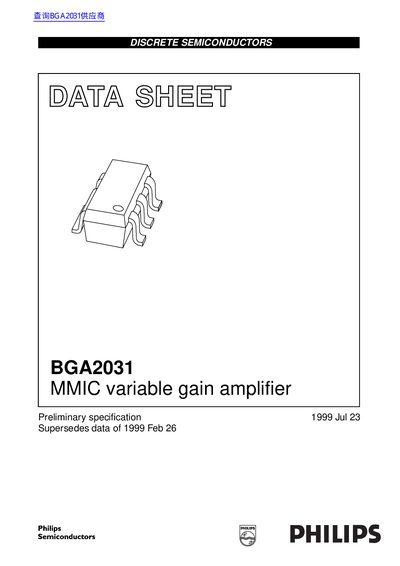
This document is a preliminary datasheet for the Philips BGA2031, a silicon monolithic microwave integrated circuit (MMIC) designed as a two-stage variable gain amplifier. It utilizes double polysilicon technology and is housed in a 5-pin SOT551A plastic surface-mount device (SMD) package. The component is intended for low voltage and medium power applications, specifically serving as a general-purpose variable gain amplifier or a driver for power amplifiers in systems requiring good linearity, such as CDMA cellular bands.
| Supply Voltage | 2.7 to 4.1 V |
|---|---|
| Frequency Range (PCS) | 1850 - 1950 MHz |
| Frequency Range (Cellular) | 824 - 849 MHz |
| Power Gain (PCS) | 26 dB |
| Gain Control Range (PCS) | 70 dB |
| Adjacent Channel Power Rejection (PCS) | 48 dBc |
| Package Type | 5-pin SOT551A |
| Operating Junction Temperature | -65 to +150 °C |
It is a general purpose variable gain amplifier for low voltage and medium power applications, or a driver for power amplifiers in systems requiring good linearity like CDMA.
The supply voltages range from 2.7 V to 4.1 V.
The maximum operating junction temperature is 150 °C.