
The document describes the detection of the major metabolite of cocaine in the hair of 2000-year-old Chilean mummies. This is particularly important in relation to Rohypnol® because victims of the drug may not immediately realize they have been violated. However, hair analysis is challenging due to the difficulty in digesting the matrix and the low concentrations of the metabolite. Therefore, the sensitivity must be in the picogram per milligram range. The metabolism of flunitrazepam produces the 7-aminoflunitrazepam metabolite through the reduction of the nitro-group. Flunitrazepam is a benzodiazepine marketed by Hoffman-La Roche under the brand name of Rohypnol®. It is not legally used in the United States, but its abuse has been increasing in the southern and southwestern regions. The relatively low street price and high potency of Rohypnol® are of particular concern.
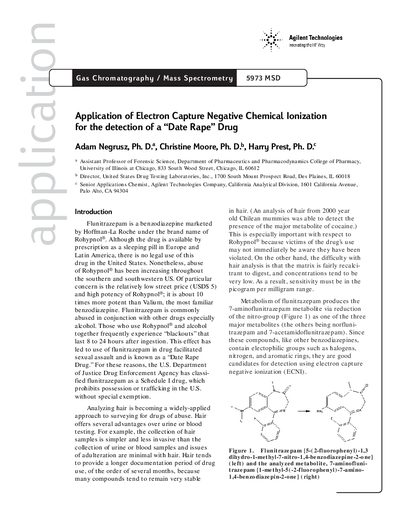
The document details an analytical method for detecting flunitrazepam, commonly known as the "Date Rape" drug Rohipnol, in biological matrices such as hair and urine. It highlights the advantages of Electron Capture Negative Ionization (ECNI) over standard methods due to higher sensitivity required for low-concentration samples.
The text outlines a specific sample preparation protocol involving pulverizing hair, extraction with methanol and acid, solid-phase extraction, and derivatization using heptafluorobutyric acid anhydride (HFBA). The method utilizes an Agilent Technologies 6980/5973 GC/MSD system operating in selected ion monitoring mode to quantify the parent compound and its metabolite.
The method showed a linear response ratio for flunitrazepam concentrations ranging from 2.5 to 200 pg/mg.
The response ratio for the 7-aminoflunitrazepam metabolite was linear from 500 fg/mg to 100 pg/mg.
The study analyzed a postmortem hair sample weighing only 9 mg.