
This Application Note describes the separation and identification of phytoestrogens in red clover using UV-visible and fluorescence detection.
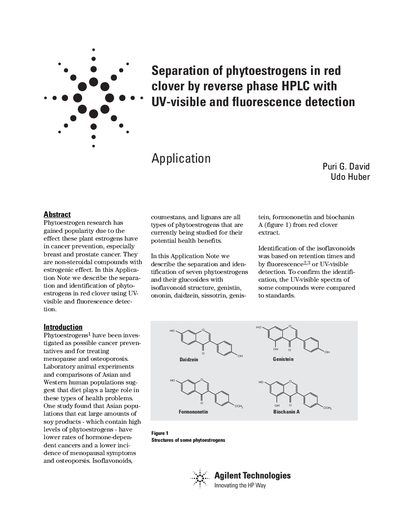
This document details a method for separating and identifying eight specific phytoestrogens (genistin, ononin, daidzein, sissotrin, genistein, coumestrol, formononetin, and biochanin A) found in red clover extract. The study utilizes reverse phase HPLC coupled with both UV-visible and fluorescence detection to achieve baseline separation and accurate identification.
| Flow rate | 1.0 ml/min |
|---|---|
| Column temperature | 35°C |
| UV detection wavelength | 260 nm / 40 (ref. 380 nm/30) |
| Fluorescence excitation | 249 nm |
| Fluorescence emission | 419 nm |
Fluorescence detection is more selective, making it easier to identify compounds in complex extracts and allowing for the identification of coumestrol which co-elutes with genistein.
Mobile phase A was 0.1 % H3PO4 in water, and Mobile phase B was 0.1 % H3PO4 in acetonitrile.