
This document describes a method for extracting quinine from serum using a Zorbax SPE C18 column. The method is illustrated with a flow chart, a list of reagents, a sample preparation method, chromatographic conditions, and sample results.
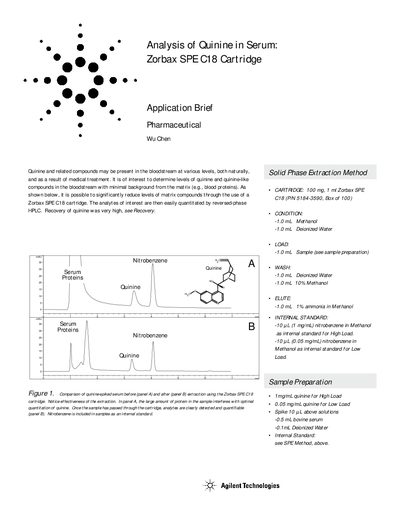
The document details an analytical procedure to determine levels of quinine and related compounds in blood serum. It highlights how the Zorbax SPE C18 cartridge effectively reduces matrix interference from proteins, allowing for clear quantitation via reversed-phase HPLC.
A complete solid phase extraction (SPE) method is provided, including specific steps for conditioning, loading, washing, and eluting samples using methanol, water, and ammonia. The document also includes an associated HPLC method with column specifications and flow rates.
The procedure requires adding 1.0 mL of methanol and 1.0 mL of deionized water to condition the cartridge, followed by loading 1.0 mL of sample, washing with 1.0 mL of deionized water and 1.0 mL of 10% methanol, and finally eluting with 1.0 mL of 1% ammonia in methanol.
To prepare a high load solution, mix 1 mg/mL quinine with 0.5 mL bovine serum and 0.1 mL deionized water; for a low load solution, use 0.05 mg/mL quinine mixed with the same volumes of serum and water.
The recovery rate is 91.6% for a concentration of 20 ug/ml and 86.4% for a concentration of 1 ug/ml.