
The sequencing of oligosaccharides in glycosylated natural products was successfully investigated using liquid chromatography-mass spectrometry with electrospray ion source in negative ion mode.
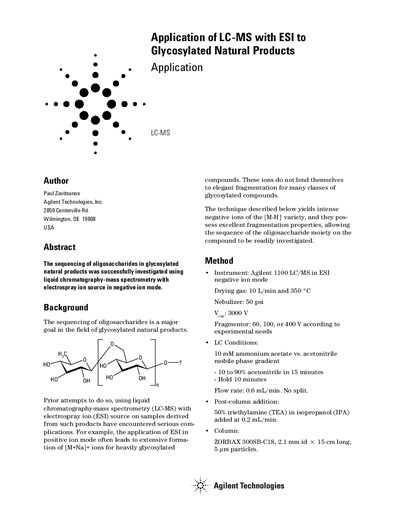
This document details a method for sequencing oligosaccharides in glycosylated natural products using liquid chromatography-mass spectrometry (LC-MS) with an electrospray ionization (ESI) source in negative ion mode. The technique is designed to overcome complications often encountered with positive ion mode, such as the formation of [M+Na]+ ions which hinder fragmentation analysis. By utilizing negative ion mode, the method yields intense [M-H] ions with excellent fragmentation properties.
| Instrument | Agilent 1100 LC/MS |
|---|---|
| Drying gas flow | 10 L/min |
| Drying gas temperature | 350 °C |
| Nebulizer pressure | 50 psi |
| Vig | 8000 V |
| Fragmentor voltage | 60, 100, or 400 V |
| Mobile phase | 10 mM ammonium acetate vs. acetonitrile |
| Flow rate | 0.6 mL/min |
| Column | ZORBAX 300SB-C18, 2.1 mm id x 15 cm long, 5 um particles |
| Post-column addition | 50% triethylamine (TEA) in isopropanol (IPA) |
The technique described yields intense negative ions of the [M-H] variety, which possess excellent fragmentation properties.
The addition of TEA post-column in the mobile phase aids the formation of negative ions from heavily glycosylated species in natural products.