
This document shows the effect of different mobile phase preparation methods on retention behavior in an Agilent 1100 LC system.
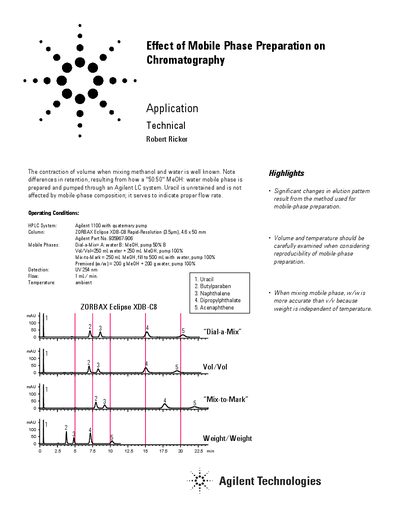
This document investigates the impact of mobile phase preparation methods on chromatography results using an Agilent 1100 HPLC system with a ZORBAX Eclipse XDB-C8 column. It compares four specific preparation techniques: Dial-a-Mix, Volume/Volume mixing, Mix-to-Mark, and Weight/Weight mixing.
| HPLC System | Agilent 1100 with quatemary pump |
|---|---|
| Column | ZORBAX Eclipse XDB-C8 Rapid-Resolution (3.5m), 4.6 x 50 mm |
| Detection | UV 254 nm |
| Flow Rate | 1 mL/ min |
| Temperature | ambient |
Weight/Weight (w/w) is more accurate than volume/volume because weight is independent of temperature.
Uracil is unretained and serves to indicate proper flow rate.