
The document describes the features and characteristics of the bq2060A SBS-Compliant Gas Gauge IC, including accurate measurement of available charge in NiCd, NiMH, Li-Ion, and lead-acid batteries, support for SBS Smart Battery Data Specification v1.1, support for the 2-wire SMBus v1.1 interface, reporting of individual cell voltages, monitoring and control of charge and discharge FETs in Li-Ion protection circuit, 15-bit resolution for voltage, temperature, and current measurements, measurement of charge flow using a V-to-F converter with offset of less than 16µV after calibration, power consumption of less than 0.5mW, and driving a 4- or 5-segment LED display for remaining capacity indication.
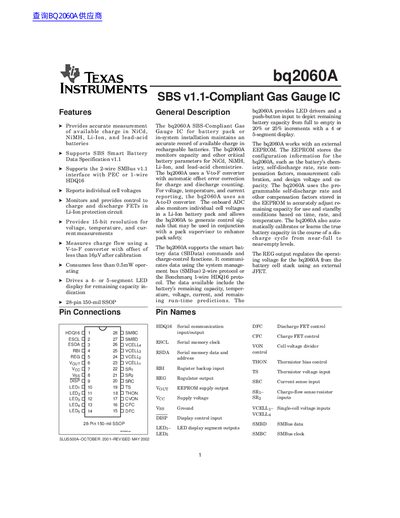
The bq2060A is an SBS-Compliant Gas Gauge IC designed for battery pack or in-system installation. It maintains an accurate record of available charge in rechargeable batteries, supporting NiCd, NiMH, Li-Ion, and lead-acid chemistries. The device uses a V-to-F converter with automatic offset error correction for charge and discharge counting and an A-to-D converter for voltage, temperature, and current reporting.
The bq2060A communicates data using the SMBus 2-wire protocol or the 1-wire HDQ16 protocol. It provides LED drivers and a push-button input to depict remaining battery capacity. The chip works with an external EEPROM to store configuration information such as battery chemistry, self-discharge rate, and measurement calibration. It also includes features for monitoring individual cell voltages in Li-Ion packs and controlling charge/discharge FETs for pack safety.
| Supported Battery Chemistries | NiCd, NiMH, Li-Ion, and lead-acid |
|---|---|
| Interface Support | SMBus v1.1 and 1-wire HDQ16 |
| Resolution | 15-bit |
| Operating Power Consumption | Less than 0.5mW |
| Package Type | 28-pin 150-mil SSOP |
| Charge Measurement Rate | 6.25uV/h |
| Offset Calibration Resolution | Less than 1V |
The bq2060A supports NiCd, NiMH, Li-Ion, and lead-acid batteries.
It uses the SMBus 2-wire protocol or the 1-wire HDQ16 protocol.
It uses a V-to-F converter with automatic offset error correction.
It consumes less than 0.5mW while operating.