
Antibodies are a group of proteins that are the key to directed immunological interaction. They can bind to an antigen (protein, glycoprotein, DNA, etc.) with extreme specificity. This property makes antibodies very valuable for use in diagnostics, general research, and for therapeutics. Treatment of intact antibodies with various chemicals and enzymes allows the specific separation of the heavy and light chains, removal of sugar moieties, and/or cleavage of the polypeptide chains. Separation of the peptide fragments (mapping) after cleavage with a proteolytic enzyme of high specificity, such as Lys-C, gives a characteristic and reproducible pattern of peaks which can be collected, sequenced, and run through a mass spectrometer (MS). This application note demonstrates the utility of using superficially porous chromatographic media (Poroshell) to achieve substantial improvements in analysis turnaround times when running high-resolution peptide maps. Figure 1 shows comparative peptide maps of a human monoclonal antibody, Lys-C digest. Note the time scales of the separations. The Poroshell maps take one-sixth of the turnaround time and show essentially the same number of peaks. See Table 1. High Speed and ultra High Speed Peptide Mapping of Human Monoclonal IgG on ZORBAX Poroshell 300SB-C18, C8, and C3 Application Biochemical Cliff Woodward, Robert Ricker, Kurt Forrer, Patrik Röethlisberger
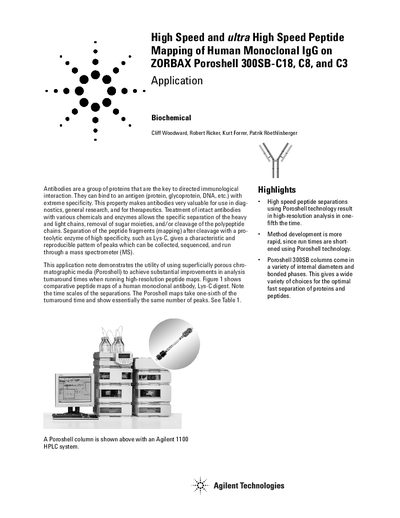
This document describes an application for high-speed and ultra-high-speed peptide mapping of human monoclonal IgG using superficially porous chromatographic media (Poroshell). The authors demonstrate that using ZORBAX Poroshell 300SB columns (C18, C8, and C3) significantly reduces analysis turnaround time compared to standard competitor columns while maintaining high resolution and peak recognition.
| Column Type | ZORBAX Poroshell 300SB-C18, C8, and C3 |
|---|---|
| Column Dimensions (Poroshell) | 2.1 x 75 mm |
| Particle Size | 5 µm |
| Run Time (High Speed) | 20.5 min |
| Run Time (Ultra High Speed) | 5.6 min |
| Flow Rate | 1.0 mL/min |
| Temperature | 70°C |
| Detection | UV, 210 nm |
| Injection Volume | 10 µL |
Poroshell maps take one-sixth of the turnaround time compared to competitor columns.
The productivity increase is over 20-fold compared to standard 120-minute runs.
No, the resolution loss does not impact the search for tryptophan-containing peptides.