
This Application Note describes the rapid development of a MRM method for triple quadrupole mass spectrometry, the rapid development of a liquid chromatography method for high throughput conditions with a 1.8 µm RRHT column, the use of the developed LC/MS MRM method for rapid determina- tion of a metabolic stability profile of a pharmaceutical drug, and the relative quantification of the acquired data to generate the metabolic stability profile.
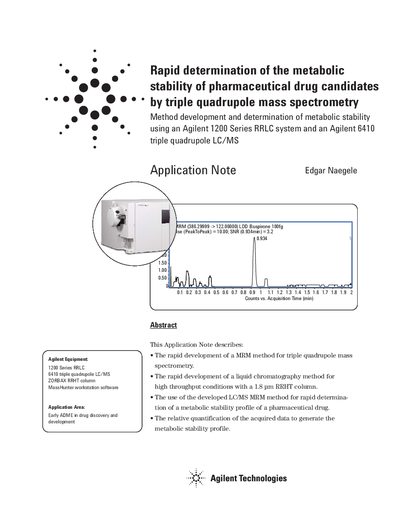
The document details a workflow for rapidly developing a Multiple Reaction Monitoring (MRM) method to determine the metabolic stability of pharmaceutical drug candidates. It utilizes an Agilent 1200 Series Rapid Resolution LC system coupled with an Agilent 6410 triple quadrupole mass spectrometer.
The limit of detection is 100 fg on column, measured with a signal-to-noise ratio of 3.2.
The optimum fragmentor voltage is 180 V.
The optimum collision energy is 30 V.