
This Application Note presents a workflow for the identification of main drug metabolites by sample comparison as well as by structure elucidation of the identified metabolites based on accurate MS and MS/MS data acquired with a quadrupole time-of-flight (Q-TOF) LC/MS. In pharmaceutical drug development the main metabolites of a new drug candidate must be identified as fast as possible and with high confidence. Software for this task is described, which analyzes the metabolized drug samples and visualizes the differences with non- metabolized drug samples for manual investigation. The structures of possible metabolites are elucidated by examination of the original highly-accurate Q-TOF mass data based on the differences between the metabolized and non-metabolized drug samples.
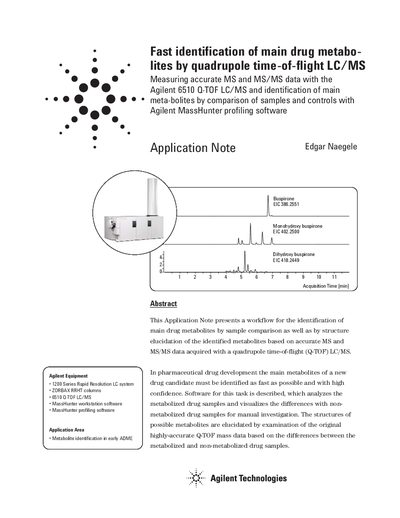
This document presents a workflow for the identification of main drug metabolites by sample comparison and structure elucidation using accurate MS and MS/MS data. The method utilizes the Agilent 6510 quadrupole time-of-flight (Q-TOF) LC/MS system combined with MassHunter Workstation and Profiling software to analyze metabolized drug samples against non-metabolized controls.
The note details a specific experimental setup involving the Agilent 1200 Series Rapid Resolution LC system and ZORBAX RRHT columns. It demonstrates the identification of buspirone metabolites, specifically mono- and di-hydroxy derivatives, by comparing abundance ratios and utilizing accurate mass data to search databases like METLIN.
| LC System | Agilent 1200 Series Rapid Resolution LC system |
|---|---|
| Column | ZORBAX Rapid Resolution High Throughput (RRHT) SB C18 Column, 2.1 x 150 mm, 1.8 um particle size |
| MS System | Agilent 6510 quadrupole time-of-flight (Q-TOF) LC/MS |
| Flow rate | 0.5 mL/min |
| Column temperature | 50 °C |
| Mass range | 50-1000 |
| Data acquisition | Data dependent, one MS spectrum per second and two MS/MS spectra per second |
MassHunter Workstation software is used for data acquisition and qualitative data analysis.
MassHunter Profiling software is used for the differential analysis of the mass data.
The incubation was carried out at 37 °C for 60 minutes.