
This Application Note is based on scientific poster MOP 253 presented at the ASMS conference of mass spectrometry, June 4, 2007, in Indianapolis, Indiana, USA. The note describes: - Rapid, computer-assisted identification of drug metabolites using a multi-algorithm approach. - High resolution chromatographic separation of drug metabolites from an in vitro experiment. - High mass accuracy measurement of drug metabolites by QTOF MS and MS/MS.
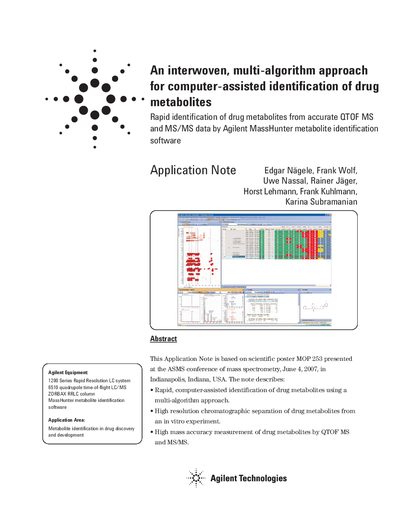
This document details a scientific method for the rapid identification of drug metabolites in discovery and development. It utilizes high-resolution chromatographic separation from an Agilent 1200 Series LC system coupled with an Agilent 6510 quadrupole time-of-flight (QTOF) LC/MS system.
The core methodology involves using the MassHunter metabolite identification software to combine multiple complementary computer algorithms. These algorithms analyze accurate mass data and MS/MS spectra from in vitro experiments, such as those involving the drug compound Nefazodone. By weighting scores from individual algorithms like sample comparison, isotopic pattern matching, and fragment pattern matching, the software generates a final relevance score to qualify potential metabolites.
| System Configuration | Agilent 1200 Series Rapid Resolution LC system and Agilent 6510 QTOF LC/MS |
|---|---|
| Column Type | Agilent ZORBAX SB-C18, 2.1 x 150 mm, 1.8 pm particle size |
| Flow Rate | 0.5 mL/min |
| Mass Range | 100-1000 |
The advantage comes when algorithms work together in an interwoven fashion and contribute to a overall result of higher confidence.
It compares detectable mass signals between a metabolized sample (time > 0) and a control sample (time = 0) to find new or increased compounds.
Metabolites are qualified when their final identification relevance score is above a defined threshold.