
This Application Note describes: • The rapid development of an MRM triple quadrupole MS method for compound quantification. • The fast liquid chromatography separation on 1.8 µm RRHT columns for high throughput of DMPK samples. • The application of the developed LC/MS MRM method for the quantification of compounds in a mixture by a multi MRM method.
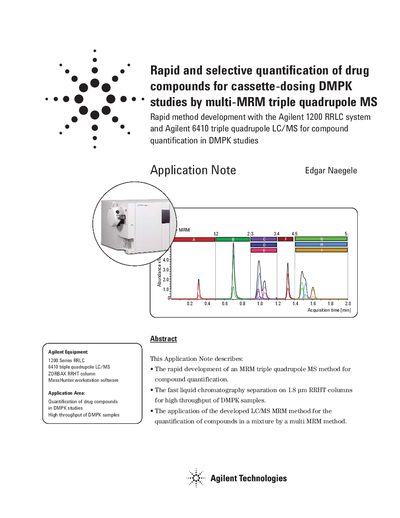
This document details the development of a multi-MRM method for the rapid and selective quantification of drug compounds in cassette-dosing DMPK studies. It addresses the need for high-throughput screening by utilizing rapid resolution liquid chromatography (RRLC) to separate compounds and a triple quadrupole mass spectrometer operating in MRM mode for sensitive detection.
| Column | Agilent ZORBAX SB C-18, 2.1 x 50 mm, 1.8 pm particle size |
|---|---|
| Flow rate | 1 mL/min |
| Injection volume | 1 pL |
| Column temperature | 50 °C |
| Source Temperature | 300 °C |
| Gas flow | 12 L/min |
| Nebulizer pressure | 60 psi |
| Capillary voltage | 4000 V |
| Dwell time | 35 ms |
| LOD for compound B | 100 fg (on-column) |
Ion suppression is overcome by using rapid resolution liquid chromatography (RRLC) to elute discrete compounds into the ion source.
A limit of detection of 100 fg on-column was determined for compound B with a signal-to-noise of 4.4.