
Using two identical columns and a second pump can achieve high-throughput analytical HPLC.
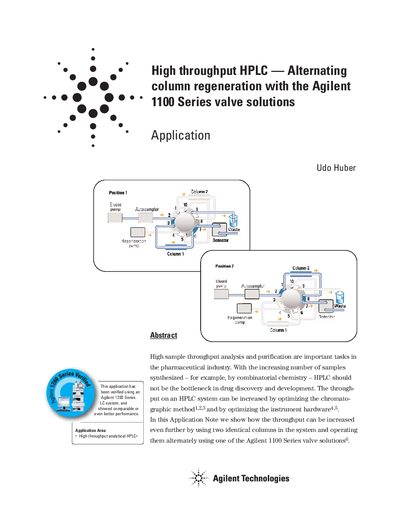
High sample throughput is critical in pharmaceutical analysis. This document details a method to increase HPLC system throughput by utilizing two identical columns and operating them alternately. The process involves switching between an eluent pump and a regeneration pump using a 2-position/10-port valve integrated into the Agilent 1100 Series thermostatted column compartment.
The note evaluates different configurations, including sequential runs versus alternating regeneration with isocratic or gradient pumps. It demonstrates that cycle times can be reduced by approximately 30% to 40% depending on whether column wash and equilibration are performed during the next analysis run and if overlapped injections are used.
| System Control Software | Agilent ChemStation (rev. A.09.03) |
|---|---|
| Flow Rate | 1.5 mL/min |
| Column Temperature | 40°C |
It is a procedure where two identical columns are switched between the eluent and regeneration pump using a valve, allowing wash or equilibration to occur while the next analysis runs.
Yes, if a gradient pump is used as the regeneration pump; only equilibration can be done with an isocratic pump.