
This document describes the application of Agilent 5500 or 5100 MAC Mode AFM for studying zinc-induced DNA kinking. It highlights the significance of DNA bending and the advantages of AFM in detecting structural fluctuations in DNA.
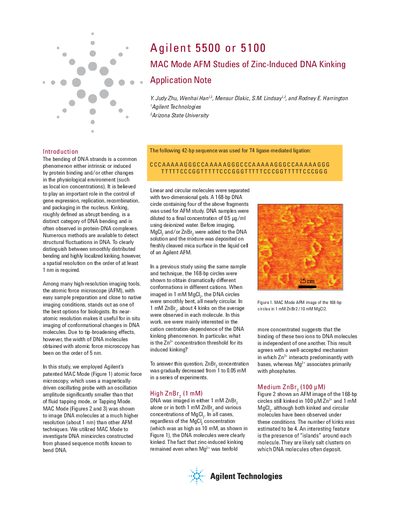
The document details a study investigating the structural fluctuations and kinking of DNA molecules. It highlights that while standard atomic force microscopy (AFM) often yields images with widths around 5 nm due to tip-broadening, Agilent's patented MAC Mode offers significantly higher resolution, approximately 1 nm.
Researchers utilized this high-resolution imaging technique on 168-bp DNA circles constructed from specific sequence motifs. The study examined how varying concentrations of zinc bromide (ZnBr2) and magnesium chloride (MgCl2) affected the conformation of these DNA molecules, specifically determining the threshold concentration for zinc-induced kinking.
| DNA Circle Size | 168-bp |
|---|---|
| Sample Concentration | 0.5 pg/ml |
A spatial resolution on the order of at least 1 nm is required.
The threshold lies between 50 uM and 100 uM.
About 4 kinks on the average were observed.