
This document describes a method for analyzing trace hydrocarbon impurities in benzene using the Agilent 7820A gas chromatograph. The method is simple to use and can be used to analyze benzene and other aromatic solvents for impurities.
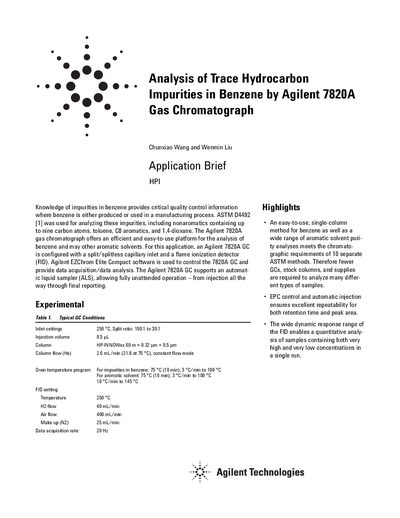
The document presents a method for analyzing impurities in benzene, including nonaromatics up to nine carbon atoms, toluene, C8 aromatics, and 1,4-dioxane. The procedure utilizes an Agilent 7820A gas chromatograph configured with a split/splitless capillary inlet and a flame ionization detector (FID), controlled by Agilent EZChrom Elite Compact software.
The application highlights the system's ability to meet the requirements of ten separate ASTM methods using a single-column method. It demonstrates excellent repeatability for retention time and peak area, as well as a wide dynamic response range that allows for the quantitative analysis of samples containing both very high and very low concentrations in a single run.
It offers an efficient platform for analyzing benzene and may other aromatic solvents.
The injection volume is set to 0.5 pL.
The hydrogen flow must be set to 40 mL/min.