
The CP2200/1 is a single-chip Ethernet controller from Silicon Laboratories. It integrates the IEEE 802.3 MAC and 10 BASE-T PHY, is fully compatible with 100/1000 BASE-T networks, supports full/half duplex auto-negotiation, automatic polarity detection and correction, automatic collision retransmission, automatic padding and CRC generation, and supports broadcast and multi-cast MAC addressing.
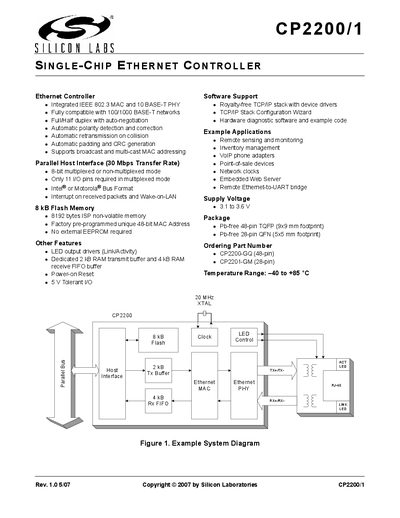
The CP2200/1 is a single-chip Ethernet controller containing an integrated IEEE 802.3 Media Access Controller (MAC) and 10 BASE-T Physical Layer (PHY). It supports full/half duplex with auto-negotiation, automatic polarity detection, and includes an 8 kB Flash memory for storing user constants or MAC addresses.
The device features a Parallel Host Interface supporting both Intel and Motorola bus formats in multiplexed and non-multiplexed modes. It is available in Pb-free 48-pin TQFP and 28-pin QFN packages, operating over a temperature range of -40 to +85 °C.
| Integrated Components | IEEE 802.3 MAC and 10 BASE-T PHY |
|---|---|
| Flash Memory Size | 8 kB |
| RAM Transmit Buffer | 2 kB |
| RAM Receive FIFO Buffer | 4 kB |
| Supply Voltage | 3.1 to 3.6 V |
| Operating Temperature Range | -40 to +85 °C |
| Package Types | Pb-free 48-pin TQFP and 28-pin QFN |
The data transfer rate in non-multiplexed mode can exceed 30 Mbps.
No, it does not require an external EEPROM as the unique 48-bit MAC Address is factory pre-programmed.
The device supports both Intel and Motorola Bus Format in multiplexed or non-multiplexed mode.