
This document introduces the application of Cary Eclipse Spectrofluorometer in microvolume sample analysis, including the use of 96 or 384 well microplate readers, fast scanning and strobed illumination.
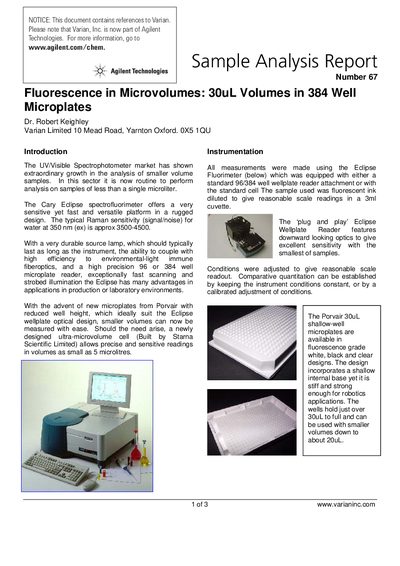
This document details a study on performing fluorescence analysis on small volume samples, specifically 30 microliters, within 384-well microplates. It highlights the capabilities of the Cary Eclipse spectrofluorimeter when coupled with shallow-well plates from Porvair Sciences.
The text presents experimental results showing that well-to-well variation is approximately +/- 5% for these conditions. The study concludes that this method provides data quality comparable to traditional cuvette measurements or larger volume analyses in standard wells.
A newly designed ultra-microvolume cell allows for precise and sensitive readings in volumes as small as 5 microlitres.
The typical Raman sensitivity for water at 350 nm is approximately between 3500 and 4500.