
Agilent Photodegredation of Protein Light Harvesting Complexes In 4ul Microvolume Samples Application Note

This document introduces the Cary 4000/5000/6000i series instruments measuring 0.8ul small volume samples functions and characteristics, and demonstrates the advantages of the series instruments in small volume, high absorption samples measurement through the study of protein light harvesting complexes photobleaching phenomenon.
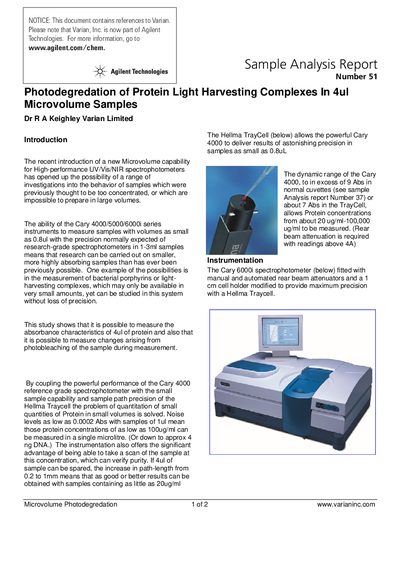

Agilent Photodegredation of Protein Light Harvesting Complexes In 4ul Microvolume Samples Application Note - cover page
Brand
Agilent
Document type
Application Note
Language
English
Pages
2
File format
PDF
File size
314 KB
Published
12 June, 2012
Updated
30 September, 2023
MD5 checksum
F4956C121763330E5680829AADDC438F

About this manual

This document describes a study on the photodegradation of bacterial porphyrins and other protein light-harvesting complexes. It highlights how the Microvolume capability of High-performance UV/Vis/NIR spectrophotometers allows for investigations into samples that are too concentrated or available only in very small amounts.

What's inside

  • Introduction
  • Instrumentation
  • Materials and Reagents
  • Conditions
  • Discussion
  • Conclusion

Frequently asked questions

What is the minimum sample volume required for this measurement?

The system can measure samples with volumes as small as 0.8ul.

What is the lowest noise level achievable with a 1ul sample?

Noise levels as low as 0.0002 Abs can be achieved with samples of 1ul.

What is the maximum absorbance reading possible in the TrayCell?

The dynamic range is about 7 Abs in the TrayCell.

Download PDF (314 KB)

More Agilent Manuals


View all Agilent manuals →