
The document describes the features and characteristics of the Cary 50 microvolume instrument for applications in biochemistry and molecular biology, including DNA/RNA, proteins, and kinetics.
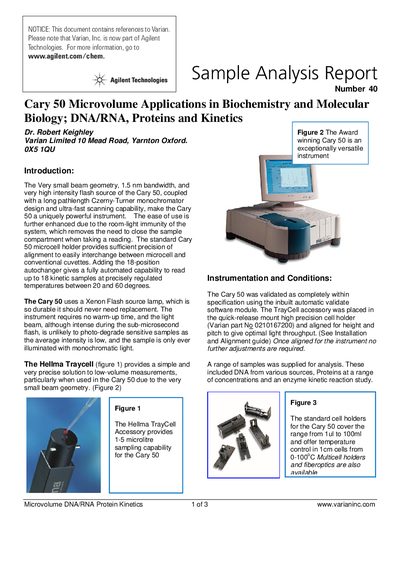
This document describes the capabilities of the Agilent Cary 50 spectrophotometer for microvolume applications in biochemistry and molecular biology. It highlights the instrument's features, such as its Xenon Flash source, room-light immunity, and compatibility with the Hellma TrayCell accessory for sampling volumes as low as 1-5 microlitres. The text notes that Varian, Inc. is now part of Agilent Technologies.
The note presents results from experiments analyzing concentrated PCR DNA samples, protein concentrations, and enzyme kinetic reactions. It demonstrates that the Cary 50, when used with the TrayCell, provides results reproducible to within less than 0.5% compared to standard cuvettes and offers excellent signal-to-noise performance for kinetic studies.
The system can read up to 18 kinetic samples at temperatures regulated between 20 and 60 degrees.
The instrument can scan 300nm in one second.