
This document describes the method of using GC/MS/MS technology to detect gasoline in fire debris. The type of hydrocarbon distillate in the fire debris was determined by comparing the sample chromatogram to the standard chromatogram. In order to overcome the interference of pyrolysis products and improve the detection level, MS/MS was used as the detection method.
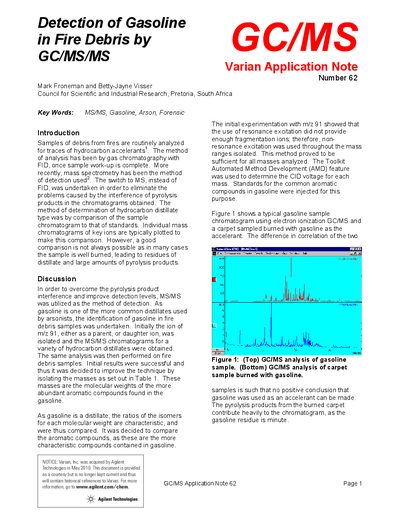
This document details a method for analyzing fire debris samples to detect traces of hydrocarbon accelerants, specifically gasoline. It addresses the limitations of standard GC/MS analysis where pyrolysis products from burned materials interfere with results. The note proposes using tandem mass spectrometry (MS/MS) to improve detection levels and selectivity.
| Column | DB-1 30M x 0.32mm ID x 0.25,1m |
|---|---|
| Injector Temperature | 180°C |
| Scan Range | 40-300 |
| Scan Rate | 0.71 Sec/Scan |
| Transfer Line Temperature | 280°C |
MS/MS was utilized to overcome interference caused by pyrolysis products in the chromatograms obtained from burned samples.
The ion of m/z 91 was isolated as the parent or daughter ion to screen for aromatic compounds in gasoline.
The oven is held at 30°C for 6 minutes, then programmed to 70°C at 7°C/min, and finally to 230°C at 10°C/min, holding for 13 minutes.