
This document describes the principle and application of Attenuated Total Reflectance (ATR) spectroscopy. ATR technique simplifies sample preparation by bringing the sample into direct contact with a high refractive index crystal, enabling total internal reflection of light. The document demonstrates the reproducibility of ATR technique and the non-destructive nature of the crystals by collecting multiple spectra from a coated aspirin sample.
This document serves as an application brief for Agilent Varian slide-on Attenuated Total Reflectance (ATR) accessories used in FT-IR microscopy. It explains the ATR technique, which relies on total internal reflection to analyze samples without microtoming, and highlights the benefits of the slide-on design for delicate samples. The slide-on ATR crystal mounts on the Cassegrain objective, allowing it to slide out of the way for standard viewing or transmission analysis and slide into position for ATR analysis, eliminating the need to swap objectives.
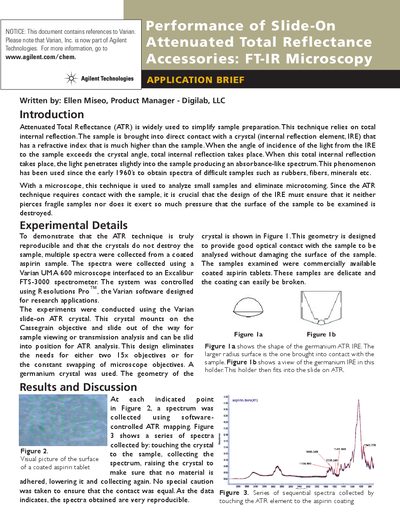
The document details experimental results demonstrating the reproducibility and safety of the slide-on ATR crystal. Using a germanium crystal on a Varian UMA 600 microscope interfaced with an Excalibur FTS-3000 spectrometer, the authors collected multiple spectra from a coated aspirin sample. The results showed that the spectra were highly reproducible and that the crystal did not damage the delicate sample surface. Additionally, contour plots were used to map chemical features, clearly indicating areas where the coating had been scraped off to expose the underlying aspirin.
The crystal mounts on the Cassegrain objective and slides out of the way for sample viewing or transmission analysis, then slides into position for ATR analysis.
A germanium crystal was used to demonstrate that the technique is reproducible and does not destroy delicate samples.
The experiments examined commercially available coated aspirin tablets, which are described as delicate materials where the coating can easily be broken.