
This application note describes the tandem mass spectrometry analysis of polybrominated flame retardants for RoHS using the Varian 240-MS ion trap gas chromatograph/mass spectrometer. It provides an overview of polybrominated diphenyl ethers, including their molecular structure and their use in fire retardants for furniture and vehicles. The document also discusses the Restriction of Hazardous Substances (RoHS) directive, which restricts the use of certain hazardous materials in products. It specifically mentions the banned compounds and includes an analysis of DecaPBDE, which is currently exempt from the directive.
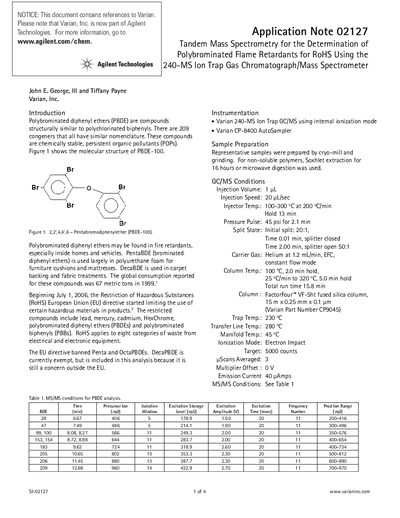
This document details an analytical method for detecting polybrominated diphenyl ethers (PBDEs) in complex matrices, such as plastics, to meet Restriction of Hazardous Substances (RoHS) requirements. The method utilizes tandem mass spectrometry (MS/MS) to achieve high sensitivity and selectivity for various PBDE congeners, including BDE 209.
The procedure involves sample preparation via cryo-milling or Soxhlet extraction, followed by analysis using a Varian (now Agilent) 240-MS Ion Trap GC/MS system. Key instrument conditions include a FactorFour VF-5ht column, electron impact ionization, and specific MS/MS isolation and excitation parameters. The method demonstrates the ability to detect analytes at low parts-per-billion (ppb) levels and maintains stability over multiple injections of complex samples.
| Injection Volume | 1 pL |
|---|---|
| Injector Temperature | 200 °C |
| Carrier Gas | Helium at 1.2 mL/min |
| Column Type | FactorFour VF-Sht fused silica column |
| Column Dimensions | 15m x 0.25mm x 0.1 µm |
| Ionization Mode | Electron Impact |
| Trap Temperature | 230 °C |
| Transfer Line Temperature | 280 °C |
| Total Run Time | 15.8 min |
The calibration range for BDE 209 (Deca) is from 10 ppb to 1 ppm.
The calibration range is 50 to 500 ppb for all BDEs except Deca.
The analysis uses a Varian 240-MS Ion Trap GC/MS using internal ionization mode.