
Describes some applications of UV-Visible derivative spectroscopy, including clinical, pharmaceutical, biochemical (life sciences), inorganic and other areas. It introduces the basic principles and application methods of derivative technology.
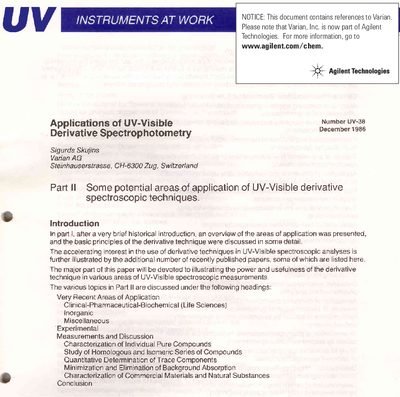
This document serves as a technical guide illustrating the power and usefulness of UV-Visible derivative spectroscopic techniques. It focuses on Part II applications, covering very recent areas such as clinical-pharmaceutical-biochemical analysis, inorganic studies, and miscellaneous topics including the characterization of pure compounds and commercial materials.
The text details experimental measurements performed using a Varian DMS 200 microprocessor-controlled double-beam UV-Visible scanning spectrophotometer. It highlights the instrument's built-in capabilities for measuring derivatives from the first to the sixth order, its automatic dark current compensation, and its ability to resolve overlapping absorption bands in difficult spectral regions.
| Wavelength Range | 190 to 900 nm |
|---|---|
| Derivative Capabilities | 1st to 6th derivative |
| Chopper Frequency | 30 Hz |
The measurements were carried out on a Varian DMS 200 microprocessor controlled, double-beam UV-Visible scanning spectrophotometer.
The instrument has a specified wavelength range of 190 to 900 nm.
Yes, the 3-segment design provides automatic dark current compensation every chopper cycle.