
This document describes a new method developed by the U.S. Environmental Protection Agency (EPA) for the measurement of volatile organic compounds (VOCs) in drinking water. The method, known as EPA 524.3, is a direct update of the earlier version of EPA Method 524.2. Key differences include the use of solid acid preservatives, a revised target list, an option for use of selected ion monitoring (SIM), and more flexible guidance for optimizing purge-and-trap parameters. Varian, Inc.'s application lab has chosen to participate in a Secondary Laboratory Demonstration study conducted by EPA to help evaluate the new method. Participants are required to perform acceptable calibration analysis, provide precision and accuracy data, and establish Lowest Concentration Minimum Reporting Levels (LCMRLs) for select regulated compounds.
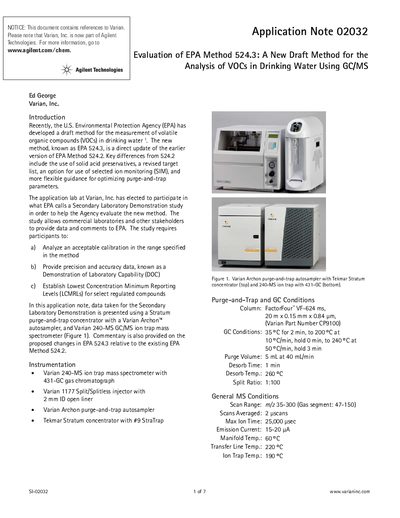
This document presents an evaluation of the U.S. Environmental Protection Agency's (EPA) draft Method 524.3 for measuring volatile organic compounds (VOCs) in drinking water. The study utilizes a Varian Archon purge-and-trap autosampler and a Varian 240-MS ion trap mass spectrometer to demonstrate the method's capabilities.
| Column Length | 20m |
|---|---|
| Purge Volume | 5 mL |
| Desorb Temp. | 260 °C |
| Scan Range | m/z 35-300 |
The new method restricts purge volume to 5 mL, allows dry purge with flexible settings, replaces HCl preservatives with maleic acid and ascorbic acid, and requires a chilled autosampler.
The method mandates a limited sample purge volume of 5.0 mL.
The method requires the samples to be kept at 10 °C during analysis.
The lowest calibration standard must have a recovery between 50-150%.