
This application note describes the use of digital signal processing (DSP) technology to demodulate detector signals in Fourier transform infrared (FT-IR) instruments for polarization modulation IR measurements.
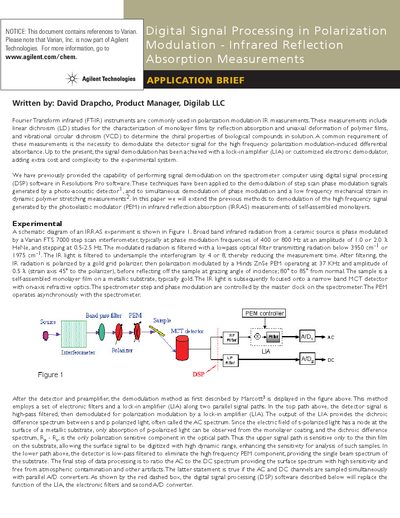
This document explains how to perform signal demodulation on the spectrometer computer using digital signal processing (DSP) software within the Resolutions Pro suite. It addresses the need to demodulate detector signals for high-frequency polarization modulation-induced differential absorbance in Fourier Transform infrared (FT-IR) instruments, replacing traditional lock-in amplifiers to reduce system cost and complexity. The text details the application of these techniques to infrared reflection absorption (IRRAS) measurements of self-assembled monolayers using a photoelastic modulator (PEM).
The document outlines the experimental setup, including the use of a Varian FTS 7000 step scan interferometer and a Hinds ZnSe PEM operating at 37 KHz. It describes the DSP algorithm used to undersample the detector signal, reducing data file sizes from hundreds of megabytes to manageable levels without sacrificing sensitivity. The text also covers the mathematical methods for determining phase errors and refining the PEM frequency to compute static absorbance and polarization modulation spectra.
The PEM operates at a frequency of 37 KHz.
The phase modulation is typically performed at an amplitude of 1.0 or 2.0 A HeNe.
The light reflects off the sample at a grazing angle of incidence between 80° and 85° from normal.