
This document describes the analysis of USP-467 residual solvents using Agilent J&W FactorFour VF-WAXms GC columns. The article lists the technical parameters of the GC column and experimental conditions used, and provides chromatograms for the identification of 26 residual solvents involved.
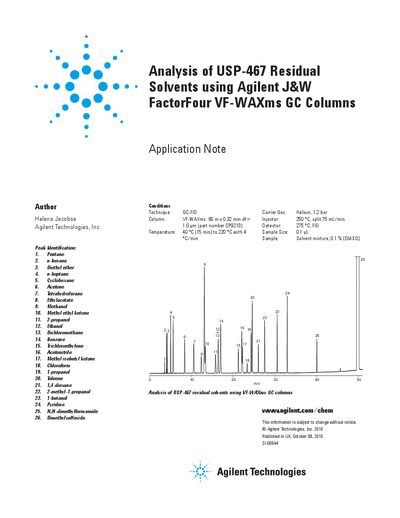
The document provides an application note for analyzing residual solvents according to USP-467 standards. It specifies the use of Agilent J&W FactorFour VF-WAXms capillary gas chromatography (GC) columns, specifically part number CP9213.
The text outlines the specific operating conditions required for the analysis using a GC-FID system. These include temperature programming from 40 °C to 220 °C, helium as the carrier gas at 1.2 bar, and injection/detector temperatures of 250 °C and 275 °C respectively.
| Column Part Number | CP9213 |
|---|---|
| Temperature Range | 40 °C to 220 °C |
| Ramp Rate | 4 °C/min |
| Carrier Gas Pressure | 1.2 bar |
| Injector Temperature | 250 °C |
| Detector Temperature | 275 °C |
The document lists pentane, n-hexane, diethyl ether, n-heptane, cyclohexane, acetone, tetrahydrofuran, ethylacetate, methanol, methyl ethyl ketone, 2-propanol, ethanol, dichloromethane, benzene, trichloroethylene, acetonitrile, methyl isobutyl ketone, chloroform, 1-propanol, toluene, 1,4-dioxane, 2-methyl-1-propanol, 1-butanol, pyridine, N,N-dimethylformamide, and dimethylsulfoxide.
The method identifies pentane, n-hexane, diethyl ether, n-heptane, cyclohexane, acetone, tetrahydrofuran, ethylacetate, methanol, methyl ethyl ketone, 2-propanol, ethanol, dichloromethane, benzene, trichloroethylene, acetonitrile, methyl isobutyl ketone, chloroform, 1-propanol, toluene, 1,4-dioxane, 2-methyl-1-propanol, 1-butanol, pyridine, N,N-dimethylformamide, and dimethylsulfoxide.
The column temperature starts at 40 °C held for 15 minutes, then ramps to 220 °C at a rate of 4 °C per minute.