
This article discusses the widespread use of vanilla extract as a flavoring ingredient in foods and beverages. The main compounds in vanilla extract are vanillin, 4-hydroxybenzaldehyde, vanillic acid, and 4-hydroxybenzoic acid. Due to limited availability and high prices of natural vanilla extract, artificial vanilla flavors are often used. It is important to differentiate between natural and artificial vanilla flavors. The article presents a conventional HPLC method and a UHPLC method for analyzing various natural and artificial vanilla flavors.
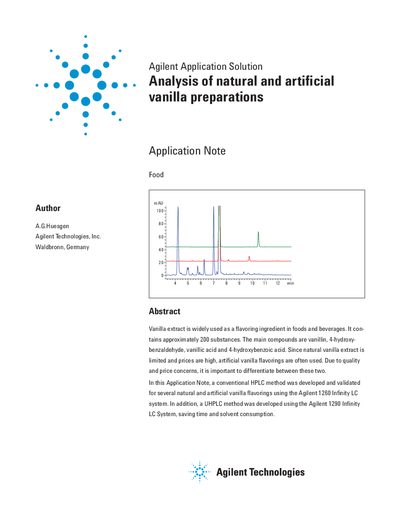
Vanilla extract contains approximately 200 substances, with main compounds including vanillin, 4-hydroxybenzaldehyde, vanillic acid, and 4-hydroxybenzoic acid. Due to quality and price concerns, differentiating between natural and artificial vanilla flavorings is important. Artificial flavorings often contain synthetically produced vanillin, ethyl vanillin, guaiacol, eugenol, and piperonal.
The typical calibration range for coumarin is 1-25 pg/mL.
The flow rate for the conventional method is 1 mL/min.