
This document describes the features and characteristics of the TPCS8212 field-effect transistor, which is suitable for lithium-ion battery applications. It has a small footprint and thin package, low drain-source ON resistance, high forward transfer admittance, low leakage current, enhancement mode, as well as maximum voltage and power ratings.
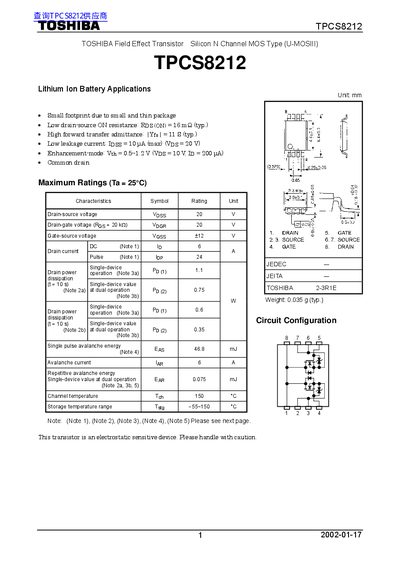
This document is a technical datasheet for the TOSHIBA TPCS8212, an N-channel Silicon MOS Type (U-MOSIII) Field Effect Transistor. The device features a small footprint and is specifically optimized for Lithium Ion Battery Applications.
Key electrical characteristics include a low drain-source ON resistance of 16 mΩ typical, high forward transfer admittance of 11 S typical, and very low leakage current of 10 pA maximum at Vgs = 20V. The transistor operates as an enhancement-mode device with a threshold voltage between 0.5V and 1.2V.
| Drain-source voltage (Vdss) | 20 V |
|---|---|
| Gate-source voltage (Vgss) | +12 V |
| Pulse Drain current (IpP) | 24 A |
| Drain-source ON resistance (Rds(ON)) typ. | 16 mΩ |
| Forward transfer admittance (|Yfs|) typ. | 11 S |
| Leakage current (Ipgg) max. | 10 pA |
| Threshold voltage (Vth) | 0.5~1.2 V |
The device is specifically designed for Lithium Ion Battery Applications.
It is an Enhancement-mode device with a threshold voltage of 0.5 to 1.2 V.
The maximum rating is 20 V for both Drain-source voltage (Vdss) and Gate-source voltage (Vgss).