
This datasheet provides information on 4 models of 2.0A surface mount silicon Schottky diodes: CMSH2-20, CMSH2-40, CMSH2-60, CMSH2-100.
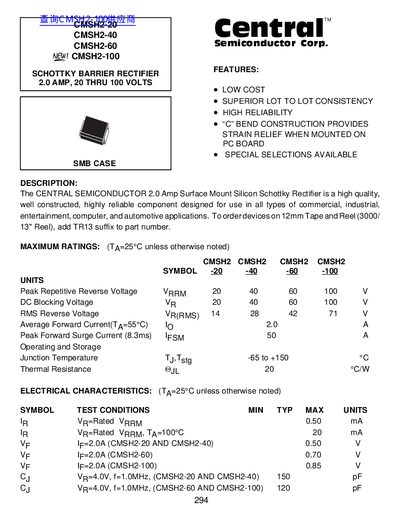
This document provides a technical overview of the Central Semiconductor Corp. CMSH2 series Schottky Barrier Rectifiers. These components are surface-mount silicon devices designed with low cost and high reliability in mind for commercial, industrial, entertainment, computer, and automotive applications.
The datasheet details maximum ratings such as peak repetitive reverse voltage ranging from 20 to 100 volts and an average forward current of 2.0 amps. It also lists specific electrical characteristics including forward voltage drop and junction capacitance for different models within the series.
| Peak Forward Surge Current (8.3ms) | 50 A |
|---|---|
| Operating and Storage Junction Temperature | -65 to +150 °C |
| Thermal Resistance QJL | 20 °C/W |
The device has a maximum average forward current of 2.0 A when the ambient temperature is 55°C.
The component operates and stores within a temperature range of -65 to +150 °C.
The peak forward surge current rating is 50 A for a duration of 8.3ms.