
The BT136 series E sensitive gate triacs are passivated, sensitive gate triacs in a plastic envelope intended for use in general purpose bidirectional switching and phase control applications where high sensitivity is required in all four quadrants.
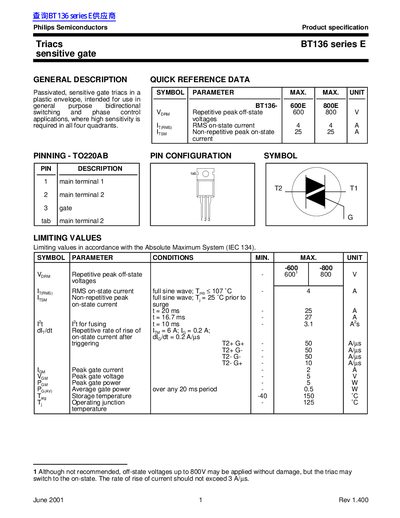
This datasheet covers the Philips Semiconductors BT136 series E sensitive gate triacs. These devices are passivated, sensitive gate triacs housed in a plastic envelope (TO220AB/SOT78), designed for general-purpose bidirectional switching and phase control applications where high sensitivity is required in all four quadrants.
| Package Type | TO220AB / SOT78 |
|---|---|
| RMS On-State Current | 4 A |
| Operating Junction Temperature | -125 to +125 °C |
Pin 1 is main terminal 1, Pin 2 is main terminal 2, and Pin 3 is the gate tab.
The maximum peak gate current (IGM) is 2 A, and the maximum peak gate voltage (VGM) is 5 V.
The typical on-state voltage (VT) at an RMS on-state current of 5 A is 1.4 V.