
NTE56051 & NTE56052 TRIAC, 8A Low Logic Level is a Nexperia product, a glass passivated, Low Logic Level TRIAC in a TO220 type package designed for use in general purpose bidirectional switching and phase control applications. These devices are intended to be interfaced directly to microcontrollers, logic integrated circuits, and other low power gate trigger circuits.
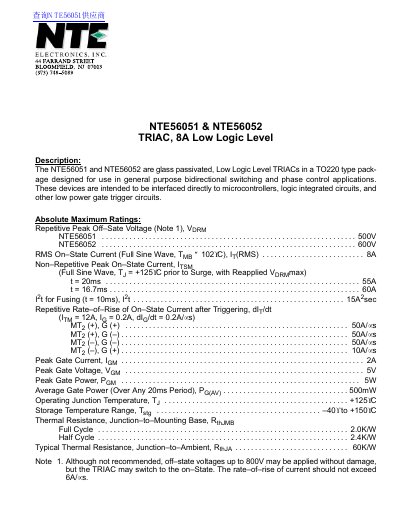
The NTE56051 and NTE56052 are low‑logic‑level TRIACs packaged in TO‑220, designed for general‑purpose bidirectional switching and phase‑control circuits. They can be driven directly from microcontrollers, logic ICs, or other low‑power gate drivers.
Key ratings include an RMS on‑state current of 8 A, off‑state voltage ratings of 500 V (56051) and 600 V (56052), a peak gate current of 2 A and peak gate voltage of 5 V, and a maximum junction temperature of +125 °C. The devices also specify thermal resistance values and a storage temperature range of –40 °C to +150 °C.
| RMS On‑State Current (IT(RMS)) | 8 A |
|---|---|
| Off‑State Voltage (VDRM) NTE56051 | 500 V |
| Peak Gate Current (IGM) | 2 A |
| Peak Gate Voltage (VGM) | 5 V |
| Gate Trigger Voltage (VGTVD) | 12 V |
The RMS on‑state current is 8 A.
NTE56051 is rated for 500 V and NTE56052 for 600 V off‑state voltage.
The peak gate voltage is 5 V.
Up to 800 V may be applied, though it is not recommended.