
EMF32 / UMF32N is a dual transistor power management circuit suitable for power management circuits. It features a power switching circuit in a single package, reducing mounting cost and area. The product employs a silicon epitaxial planar transistor structure.
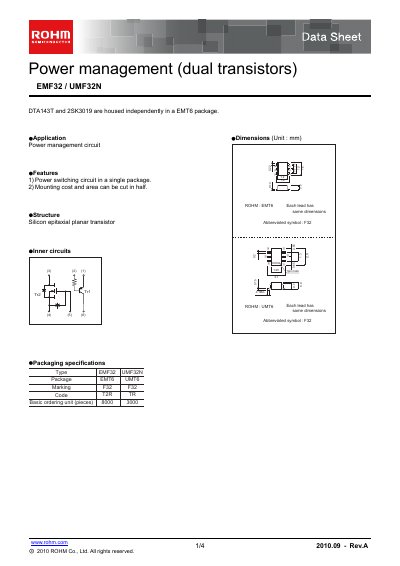
The EMF32 and UMF32N are dual‑transistor power‑management ICs offered in an EMT6 package. They combine a power switching circuit and a low‑cost, compact layout, reducing mounting area and cost.
The document lists absolute maximum ratings, electrical characteristics, and typical performance curves, along with packaging details and application notes for designing reliable power‑management circuits.
| Collector‑base voltage (Vcbo) | 50 V |
|---|---|
| Collector‑emitter voltage (Vceo) | 50 V |
| Emitter‑base voltage (Vebo) | 5 V |
| Collector current (Ic) | 100 mA |
| Power dissipation (Pd) | 150 mW (total) |
| Junction temperature (Tj) | 150 °C |
| Storage temperature range | -55 to +150 °C |
| Drain‑source voltage (Vdss) | 30 V |
| Gate‑source voltage (Vgss) | +20 V |
| Drain current (Id) | 100 mA (continuous) |
| Channel temperature (Tch) | 150 °C |
The maximum collector current is 100 mA.
Both devices are supplied in an EMT6 (or UMT6) package.
The total power dissipation is rated at 150 mW.
Collector‑base voltage is 50 V, collector‑emitter voltage is 50 V, and emitter‑base voltage is 5 V.