
This document describes a surface mount bidirectional silicon trigger diode (DIAC) with a breakdown voltage of 28 to 45 volts and a maximum power dissipation of 150 milliwatts. The product features a miniMELF plastic case with a weight of approximately 0.04 grams, and it is suitable for surface mounting on PCBs.
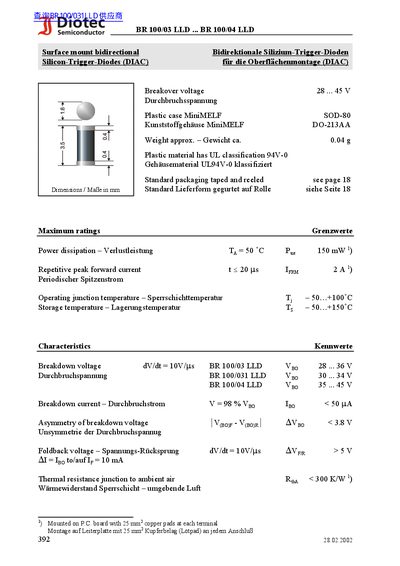
The BR 100 series are surface‑mount bidirectional silicon‑trigger diodes (DIAC) offered in a MiniMELF plastic case (SOD‑80 / DO‑213AA). They are intended for use in thyristor trigger circuits and provide reliable breakover characteristics.
Key parameters include breakover voltage ranges of 28‑36 V (BR 100/03 LLD) and 30‑34 V (BR 100/04 LLD), a maximum power dissipation of 150 mW, and a thermal resistance below 300 K/W. The devices are rated for operating junction temperatures from –50 °C to +150 °C and are supplied in standard taped‑and‑reeled packaging. This manual is written in German.
| Breakover voltage (BR 100/03 LLD) | 28 V – 36 V |
|---|---|
| Package type | SOD‑80 / DO‑213AA (MiniMELF) |
| Power dissipation | 150 mW |
| Repetitive peak forward current (20 µs) | 2 A |
| Plastic material UL classification | UL94V‑0 |
The BR 100/03 LLD has a breakover voltage range of 28 V to 36 V.
The devices are supplied in a MiniMELF plastic case, SOD‑80 (DO‑213AA) package.
The maximum power dissipation is 150 mW at a junction temperature of 50 °C.