
This document is the datasheet for the ZMD31050 Advanced Differential Sensor Signal Conditioner. The product features digital compensation of sensor offset, sensitivity, temperature drift, and non-linearity. It accommodates nearly all bridge sensor types and offers various output options. The output resolution is adjustable based on the sampling rate. The product also offers high accuracy, no external trimming components required, and PC-controlled configuration and calibration via a digital bus interface.
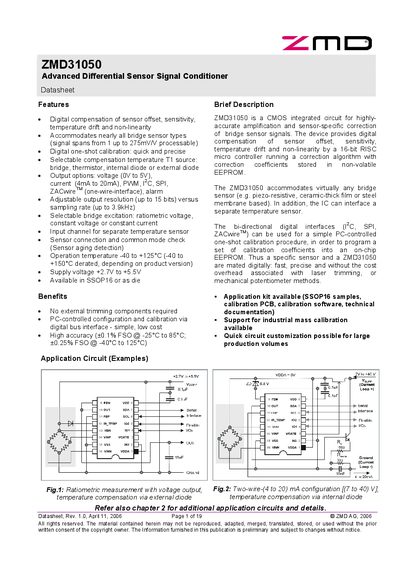
The ZMD31050 Advanced Differential Sensor Signal Conditioner is a CMOS integrated circuit that provides high‑accuracy amplification and digital correction of bridge sensor signals. It features digital compensation of offset, sensitivity, temperature drift and non‑linearity, and supports a wide range of bridge sensor types.
The device offers selectable bridge excitation, multiple output formats (voltage, 4‑20 mA current loop, PWM, PC, SPI, ZACwire™), adjustable resolution up to 15 bits, and an on‑chip EEPROM for calibration coefficients. It operates from +2.7 V to +5.5 V and is rated for –40 °C to +125 °C.
| Supply voltage | +2.7 V to +5.5 V |
|---|---|
| Operating temperature range | -40 °C to +125 °C |
| Output options | Voltage (0‑5 V), 4‑20 mA current, PWM, PC, SPI, ZACwire™ |
| Adjustable output resolution | up to 15 bits |
| Programmable gain range | 2.8 – 420 (gain steps) |
The device operates from +2.7 V up to +5.5 V.
It can output voltage (0‑5 V), a 4‑20 mA current loop, PWM, PC, SPI, or ZACwire™ one‑wire interface.
The ZMD31050 is rated for temperatures from –40 °C to +125 °C.
The output resolution is adjustable up to 15 bits.