
SN54ACT374, SN74ACT374 are two 8-bit D-type edge-triggered flip-flops, their output pins are designed with 3-state output, which makes them very suitable for driving high-capacitance or relatively low-impedance loads.
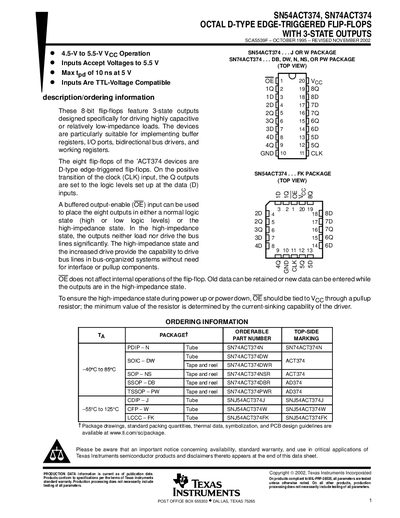
The SN54ACT374 and SN74ACT374 devices are octal D‑type edge‑triggered flip‑flops with three‑state outputs. They feature TTL‑compatible inputs, a buffered output‑enable (OE) pin, and are intended for buffer registers, I/O ports, bidirectional bus drivers, and other working registers.
The datasheet provides recommended operating conditions (‑55 °C to 125 °C), electrical characteristics such as a 4.5 V‑5.5 V supply range, up to 50 mA continuous output current, and a maximum clock frequency of 100 MHz. Various package options (PDIP, SOIC, SSOP, TSSOP, etc.) and ordering information are listed, along with mechanical drawings and an important notice about product warranties.
| Supply voltage range | 4.5 V to 5.5 V |
|---|---|
| Input voltage range | 2.0 V to 5.5 V |
| Operating temperature range (free‑air) | -55 °C to 125 °C |
| Maximum clock frequency | 100 MHz |
The devices are specified for free‑air temperatures from –55 °C to 125 °C (some packages –40 °C to 85 °C).