
This document describes the features and characteristics of LZ series capacitors, including operating temperature range, rated working voltage, capacitance tolerance, leakage current, dissipation factor, etc.
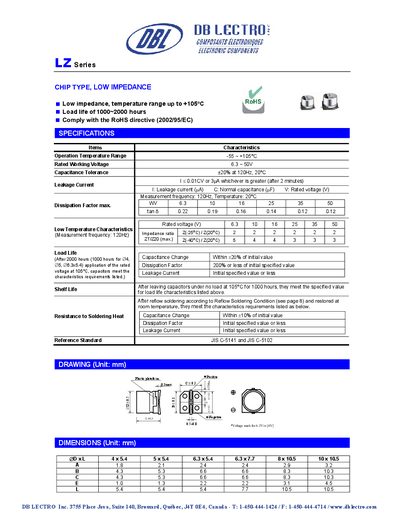
This data sheet describes the LZ Series low‑impedance aluminum electrolytic capacitors offered by DB LECTRO. It lists electrical characteristics such as operating temperature range, rated voltage, capacitance tolerance, leakage current, dissipation factor and load life, together with mechanical dimensions and permissible ripple current.
The document also includes part‑number explanations, RoHS compliance information, packaging details, and general application recommendations, including design and mounting precautions for reliable use in electronic circuits.
| Operation Temperature Range | -55 °C ~ +105 °C |
|---|---|
| Rated Working Voltage | 6.3 V ~ 50 V |
| Capacitance Tolerance | +20 % at 120 Hz, 20 °C |
| Load Life | 1000 ~ 2000 hours |
| RoHS Compliance | Yes (all chip types) |
The LZ Series capacitors operate from –55 °C up to +105 °C.
The rated working voltage spans from 6.3 V to 50 V.
The load life is specified as 1000 to 2000 hours.
Yes, all chip types in the LZ Series meet RoHS requirements.