
The MAX19997A is a dual downconversion mixer suitable for 1800MHz to 2900MHz base station applications. It provides high linearity and low noise figure, and supports both low-side and high-side LO injection architectures. It features 8.7dB gain, +24dBm input IP3, and 10.3dB noise figure in the low-side configuration.
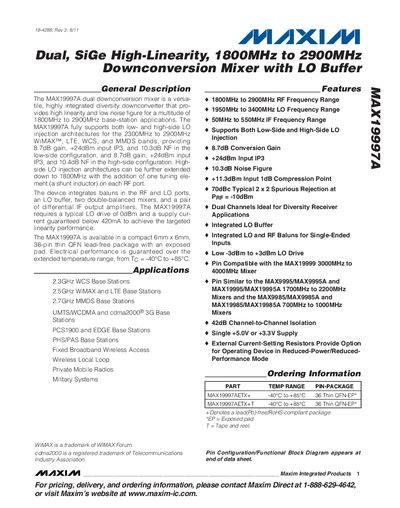
The MAX19997A is a dual, SiGe high‑linearity downconversion mixer with an integrated LO buffer. It supports both low‑side and high‑side LO injection for 1800 MHz to 2900 MHz base‑station applications such as WiMAX, LTE, WCS and MMDS. The device integrates RF and LO baluns, a double‑balanced mixer pair, and differential IF output amplifiers, and it operates from a single 3.0‑3.6 V or 4.75‑5.25 V supply.
The mixer is supplied in a 6 mm × 6 mm, 36‑pin thin QFN‑EP package with an exposed pad and is rated for –40 °C to +85 °C operation. Key performance figures include 8.7 dB conversion gain, +24 dBm input IP3, 10.3‑10.4 dB noise figure, and 42 dB channel‑to‑channel isolation.
| RF Frequency Range | 1800 MHz to 2900 MHz |
|---|---|
| LO Frequency Range | 1950 MHz to 3400 MHz |
| IF Frequency Range | 50 MHz to 550 MHz |
| Conversion Gain | 8.7 dB |
| Input IP3 | +24 dBm |
| Noise Figure (low‑side) | 10.3 dB |
| 1 dB Compression Point | +11.3 dBm |
| Supply Voltage (3 V version) | 3.0 V to 3.6 V |
| Supply Voltage (5 V version) | 4.75 V to 5.25 V |
| Operating Temperature Range | -40 °C to +85 °C |
It supports an RF frequency range from 1800 MHz to 2900 MHz.
The typical conversion gain is 8.7 dB.
In low‑side LO injection the noise figure is 10.3 dB.