
The MAX19999 is a dual-channel downconverter from Texas Instruments that provides 8.3dB of conversion gain, +24dBm input IP3, +11.4dBm 1dB input compression point, and a noise figure of 10.5dB for 3000MHz to 4000MHz WiMAX™ and LTE diversity receiver applications.
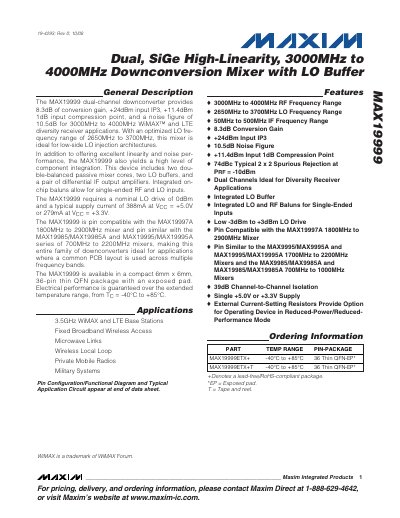
The MAX19999 dual‑channel downconverter provides 8.3 dB of conversion gain, +24 dBm input IP3, and a 10.5 dB noise figure for 3000 MHz to 4000 MHz WiMAX™ and LTE diversity receiver applications. It integrates two double‑balanced passive mixer cores, LO buffers, and differential IF output amplifiers in a compact 6 mm × 6 mm, 36‑pin thin QFN package with an exposed pad.
The device operates from –40 °C to +85 °C, with typical supply currents of 388 mA at 5 V and 279 mA at 3.3 V. It supports an LO frequency range of 2650 MHz to 3700 MHz, an IF range of 50 MHz to 500 MHz, and offers pin compatibility with other Maxim mixers for flexible PCB layouts.
| RF Frequency Range | 3000 MHz – 4000 MHz |
|---|---|
| LO Frequency Range | 2650 MHz – 3700 MHz |
| IF Frequency Range | 50 MHz – 500 MHz |
| Conversion Gain | 8.3 dB (typical) |
| Input IP3 | +24 dBm |
| Noise Figure | 10.5 dB (typical) |
| Supply Current @ 5 V | 388 mA (typical) |
| Package | 6 mm × 6 mm, 36‑pin thin QFN with exposed pad |
| Operating Temperature Range | -40 °C to +85 °C |
The MAX19999 draws about 388 mA typical supply current at VCC = +5.0 V.
It requires a nominal LO drive of 0 dBm.
The device operates from 3000 MHz to 4000 MHz.
It is supplied in a 6 mm × 6 mm, 36‑pin thin QFN package with an exposed pad.