
This manual introduces the TA045 200 MHz ±60 V differential probe, including its safety use and maintenance instructions.
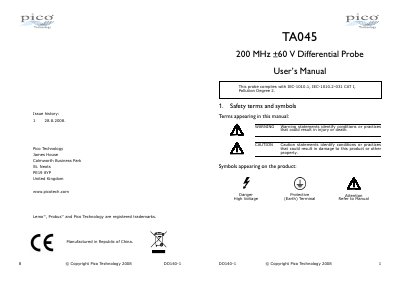
This manual covers safety terms, grounding requirements, and proper handling of the DO140-1 differential probe. It explains how to connect the probe to an oscilloscope, select a power source, and verify correct operation before use.
The specifications section lists performance data such as 200 MHz bandwidth, 1:10 attenuation, 1.75 ns rise time, and voltage limits. Installation, test procedures, cleaning, and accessories are also described to help users achieve accurate measurements.
| Bandwidth | DC to 200 MHz (-3 dB) |
|---|---|
| Attenuation ratio | 1:10 |
| Rise time | 1.75 ns |
| Input impedance | 500 kΩ // 7 pF each side to ground |
| Differential range | +20 V |
| Common mode range | +60 V |
| Absolute maximum voltage | +60 V (either input to ground) |
| Output swing (into 50 kΩ load) | +2 V |
| CMRR (typical) | -80 dB @ 100 Hz; -50 dB @ 10 MHz |
| Ambient operating temperature | -10 °C to +40 °C |
| Power requirements | 6 V DC 90 mA or 9 V DC 70 mA mains adaptor, or 4 AA cells |
The absolute maximum voltage is ±60 V (either input to ground).
The probe is grounded through the BNC connector shell and an auxiliary grounding terminal; verify the output lead is grounded before connecting the input leads.
It can be powered by a 6 V DC 90 mA or 9 V DC 70 mA mains adaptor, a removable battery pack of four AA cells, or external power leads.
The probe has a bandwidth of DC to 200 MHz (-3 dB).